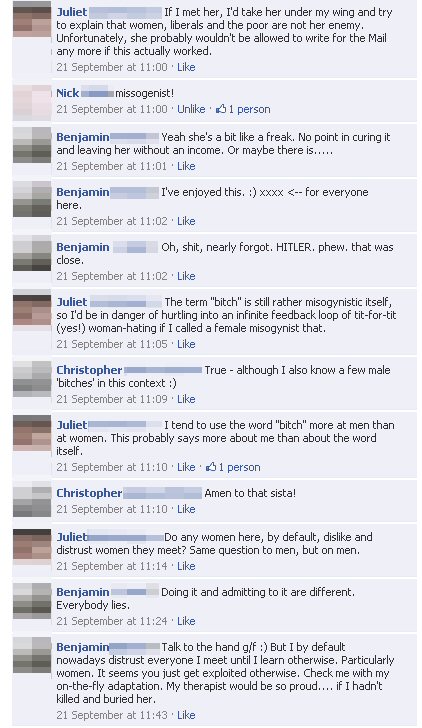
My hackles were up.
I know I shouldn’t go near the Daily Mail website but, like someone drawn to stare at a horrible road accident, I keep clicking on links I’m perfectly aware will anger me. It’s a compulsive habit. The only excuse I can muster is attempting to know thine enemy. Browser apps like this one from TomRoyal.com – where when activated, any Daily Mail website link will be automatically redirected to pictures of tea and kittens – are perfect for people like me with a tendency to poke and prod at bad journalism. Anyone would think me a masochist.
This time it was Liz Jones. When it comes to point-missing and aimless, self-pitying rants, she is unbeatable. If you like, you could click the link and look at what she wrote on this occasion. However, if you bristle at the thought of raising the Mail’s ad revenue by adding your traffic to their site (or have already installed the kitten app), I’ll summarise the column here:
It doesn’t start too badly. Jones defends Sky anchorwoman Kay Burley from accusations that she’s “a bit dim”. (For what it’s worth, I don’t think Burley is dim. I think she’s widely reviled for being the visible figurehead of an utterly malevolent corporation that does for news what the norovirus does for stomach lining – but that’s another story.) The explanation Jones then gives for Burley’s unpopularity is that she’s sexually unattractive. Which, to me, seems a bit harsh.
Yes, she’s making the point, albeit clumsily, that physical appearance is often seen to matter more than content for women in television journalism. She’s right, in a lot of cases. It’s a double standard. Except she then destroys her own argument by spending the rest of the article listing successful female broadcasters, then categorising them entirely on the basis of their looks.
Her choices are highly subjective. After commenting on exactly who she considers professional but ugly, Jones puts forward the theory that Lindsey Hilsum and Orla Guerin don’t wear headscarves in Muslim countries out of cultural sensitivity but “in case the viewers run away screaming from a middle-aged, unmade-up face”.
But those “plain” women get off lightly. Woe-betide anyone whom Jones terms a “babe”. She stops short of actually saying that they rutted their way up to distinguished careers in journalism and academia, but specifies how each “breeze through life” to get “top jobs” and “marry rich men”.
Entire careers are dismissed thus:
Newsnight’s Emily Maitliss – heavy mascara, too thin, false tan, and – horror of horrors – she went on maternity leave;
Cathy Newman of Channel 4 – a political correspondent Liz Jones inexplicably can’t concentrate on due to “boxy” jackets and “extravagant” raindrop-trapping eyelashes;
Lastly, acclaimed writer and historian Bettany Hughes – with a description so masturbatory I must quote it verbatim – “clambers over ruins in her skintight jeans, raven hair cascading over her shoulders, raspberry mouth parted as she tilts her head photogenically to the sun”. Being so dangerously attractive, it seems, is an unforgivable crime. Somehow, it is also incompatible with intellectual or practical pursuits. “Archaeology?” sneers Jones. “With those nails?”
It’s the same misogynistic tale we’ve heard over and over since the dawn of time. A woman’s personal and professional credibility can be wiped out in one fell swoop if anyone – through no fault of her own – finds her sexually appealing. She is suddenly perceived as a bimbo. She could have a multitude of academic qualifications, decades of experience and any number of awards to her name, but if she causes the slightest unexpected stirring in the loins of her admirers (or perhaps in the loins of an embittered, confused and wildly insecure Daily Mail columnist) she is dismissed as a brainless temptress.
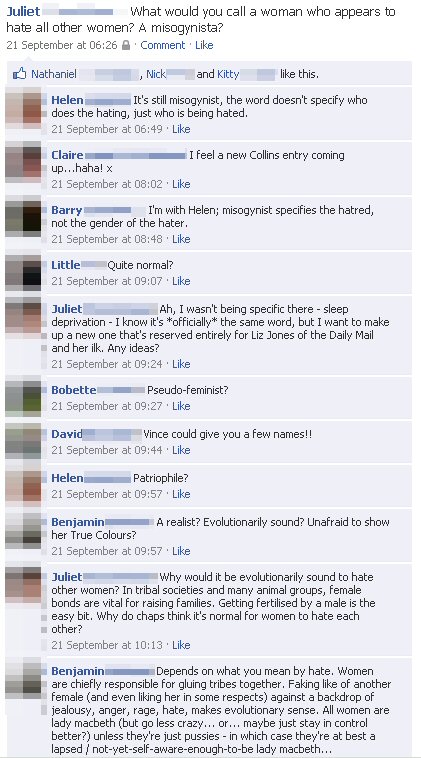
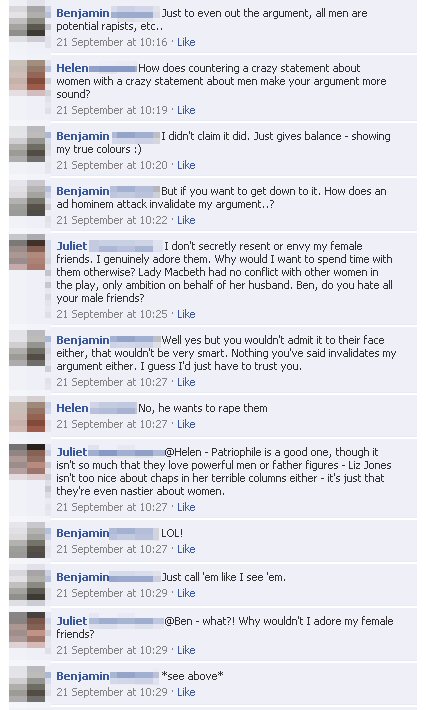
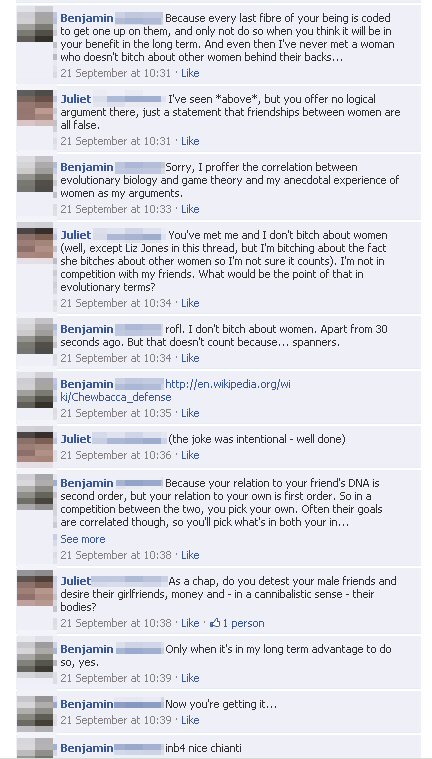
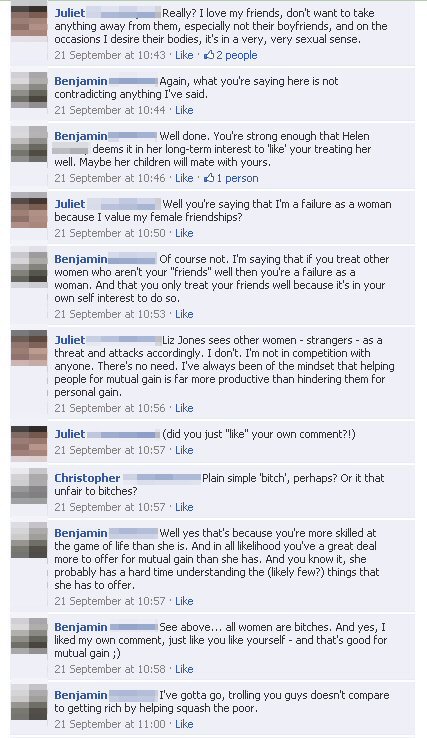
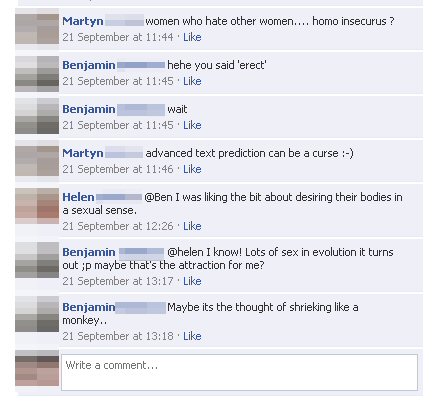
Anyway, this led to an intriguing conversation on my Facebook page about the nature of dominance, and whether being a woman who competes with other women is good or bad in evolutionary terms. (Surnames and avatars have been pixellated for the sake of anonymity. I also belatedly take back anything I said on the thread about taking Liz Jones “under my wing”. There are some things that even my tightest jeans can’t fix.) Click the thumbnails below to view sections of the thread in order.